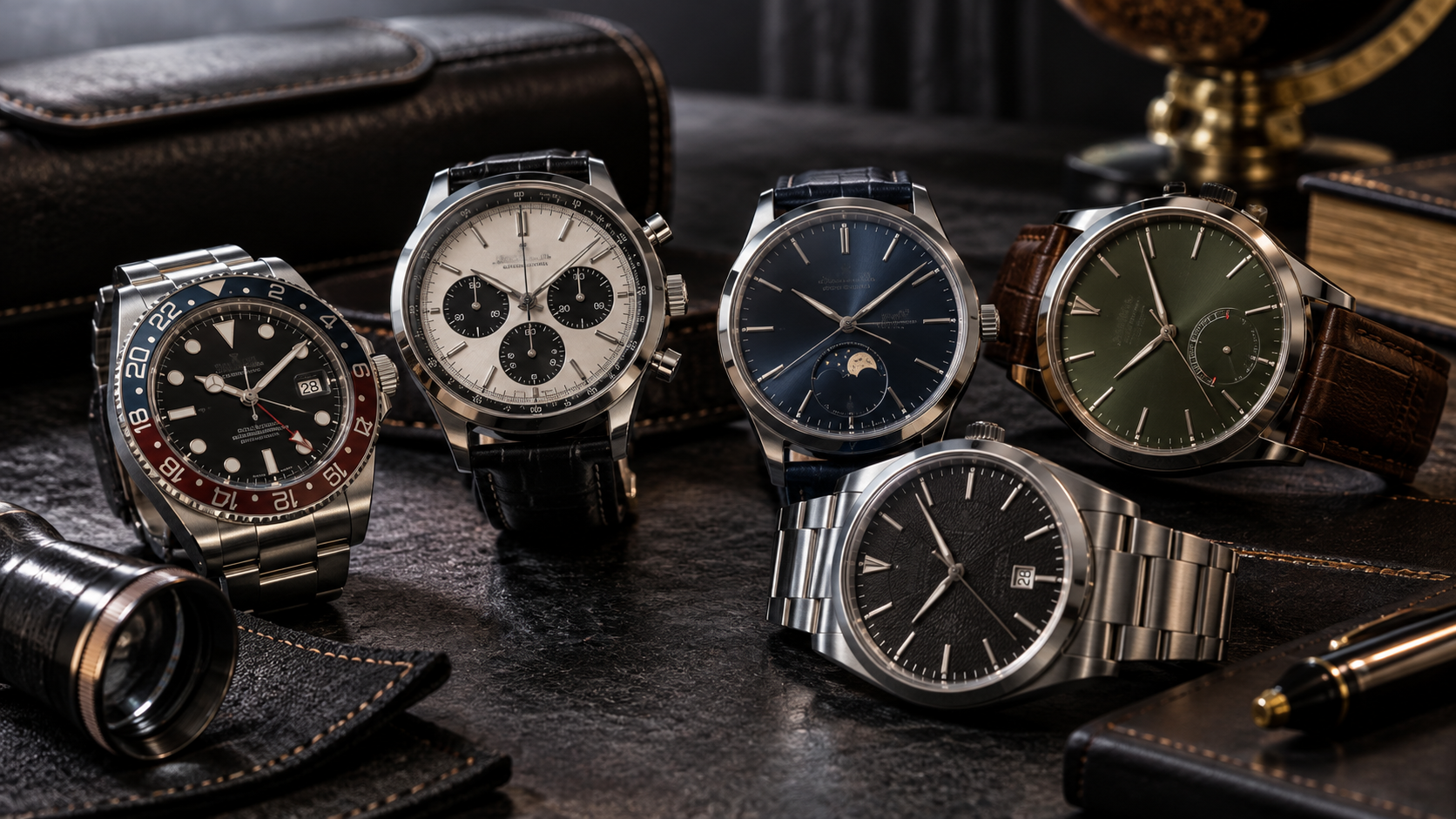
At its simplest, a watch tells time. But for many enthusiasts, the fascination begins with everything a mechanical watch can do telling beyond the hours, minutes and seconds.
In watchmaking, these additional functions are known as complications . Some were created to solve practical problems. Others demonstrate extraordinary mechanical ingenuity. And while a collector certainly doesn't need to understand every perpetual calendar or minute repeater to appreciate watches, knowing the fundamentals can make the hobby considerably more rewarding.
Here are five complications every watch enthusiast should know.
1. The Date — Simple, Useful and More Complicated Than It Looks
We see date windows so frequently that it's easy to forget the date itself is a complication.
Behind that little aperture is a mechanism designed to advance the calendar indication as the movement passes through midnight. Some watches display the date through a traditional window, while others use a date pointer or more elaborate calendar arrangement.
It's one of watchmaking's simplest complications—and arguably one of its most useful.
For collectors, it also creates an interesting design debate: date or no date?
Some prefer the everyday practicality. Others prefer the symmetry and simplicity of a clean, time-only dial.
Neither answer is wrong. That's part of collecting.
2. GMT — A Complication Built for Travel
Few complications combine practicality and visual interest as successfully as the GMT .
A GMT watch uses an additional hour hand—typically read against a 24-hour scale—to display another time zone. Depending on the movement and bezel configuration, some GMT watches can effectively reference even more.
The complication became particularly relevant during the expansion of commercial aviation, when pilots and travelers increasingly needed to keep track of time in different parts of the world.
Today, you don't need to be crossing the Atlantic to appreciate one.
For anyone with family abroad, international business interests—or simply a love of travel—the GMT remains one of the most genuinely useful complications in modern watchmaking.
3. Chronograph — A Stopwatch on Your Wrist
Pushers on the side of the case. Subdials across the dial. A long central seconds hand waiting at 12.
The chronograph is instantly recognizable.
At its core, a chronograph allows the wearer to measure elapsed time independently of the watch's normal timekeeping function.
Its history is connected to everything from motorsport and aviation to scientific timing and space exploration. But even if you've never timed a lap around a racetrack, understanding what is happening mechanically makes a chronograph fascinating.
Starting the chronograph engages an additional series of components within the movement. Stopping it freezes the elapsed-time indication. Resetting it returns the hands to zero.
What appears to be a simple push of a button represents a remarkable amount of mechanical coordination.
4. Power Reserve — How Much Time Is Left in the Tank?
Every mechanical watch needs stored energy to run.
In a manually wound watch, that energy comes from winding the crown. In an automatic watch, movement of the wearer's wrist helps wind the mainspring.
The power reserve tells us approximately how long the movement can continue operating once fully wound without receiving additional energy.
This is why specifications such as 40, 65 or 70 hours actually matter.
A watch with roughly 70 hours of reserve can, depending on its state of wind, potentially be off Friday evening and still be running when you reach for it again Monday morning.
Some watches go one step further and display the remaining reserve directly on the dial through a dedicated power-reserve indicator .
It's a wonderful example of a technical specification becoming genuinely useful in everyday ownership.
5. Moonphase — When Function Becomes Art
Not every complication needs to solve a modern problem.
The moonphase displays the progression of the lunar cycle, typically through a rotating disc visible through an aperture in the dial.
For most of us, checking the phase of the moon on our wrist isn't exactly necessary.
And that's precisely what makes it special.
The moonphase represents another side of mechanical watchmaking: creating something beautiful simply because it can be created.
Paired with dress watches and calendar complications, it often connects contemporary watchmaking to centuries of astronomical timekeeping.
It's less about utility and more about romance—and there is still plenty of room for that in this hobby.
Complications Tell Us Why a Watch Exists
Understanding complications isn't about memorizing specifications.
It's about understanding purpose .
A GMT tells the story of travel. A chronograph speaks to our desire to measure events precisely. A power reserve makes mechanical energy visible. A moonphase reminds us that watchmaking has always existed somewhere between engineering and art.
And once you understand what a watch was designed to do, you often begin looking at it differently.
That's one of the pleasures of becoming an enthusiast: the more you learn, the more there is to notice.
At The Aurora Collection , we believe collecting should be driven by curiosity as much as acquisition. Whether you're considering your first mechanical watch or adding another complication to an established collection, understanding the watch is part of enjoying it.
For Enthusiasts, By Enthusiasts.